


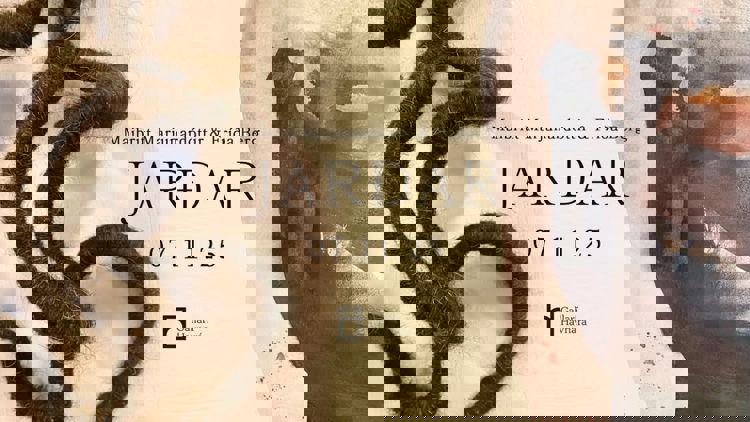
Opening reception: Jarðar – Maibritt and Fríða at Gallarí Havnará
Beinir Bergsson will open the exhibition and read poetry. Eivør will also perform songs.
Maibritt Marjunardóttir (b. 1988) is an artist and designer, educated with a Bachelor of Arts in textile design from Designskolen Kolding and a cand.design from The Royal Danish Academy in Copenhagen.
Textiles move through hands, through different lives and places, and sometimes across generations. They become entwined in our existence and carry our destinies with them. They carry everything that is invisible: traces of the hands that worked them, the scent of the places where they have been, and the stories told where they have rested.
When an object becomes exposed to time, and thus to the physically materialized or tangible narrative, it becomes charged with emotional and tactile value, transforming it into more than just an object. In a way, the object is reshaped into a vessel that can transport you back to stored—and perhaps forgotten—emotions and bodily memories.
Maibritt works with storytelling through materiality. Using traditional hand-binding and other iterative processes, she gives form to stories with a monochromatic, dark, and often somber tone.
Fríða Berg (b. 1984) is a trained furniture maker and architect from The Royal Danish Academy in Copenhagen.
She explains that her works are based on her interest in materiality and the interplay between nature and the human-made. It is an exploration of how the abstract and the tangible can coexist.
Color and surface, paper and wood, texture and depth—these can be understood as readings in which earthly landscapes and sometimes the human-made and mechanical merge.
A trace in which objects are experienced simultaneously, where the experience forms a shared foundation between the emotional and the physical. Thoughts about material, tactility, and composition recur in her architectural work, where events and material experiences often become the basis for deeper observation.
“Jarðar” operates in the subconscious—between reality and imagination—a trace in which objects are experienced simultaneously. One can read the works as a landscape where experiences and memories intertwine. The work aims to create the opposite of separation, an attempt to form a coherence that can only be lived through the work itself.

 torsinfo@torshavn.fo
  +298 30 24 25
  Facebook
  Instagram