


Amalie Joensen (b. Müller) (1866-1944)
One of the first five women to graduate as teachers from the School of Education in Tórshavn in 1887. Amalia spent a long period in Greenland, where her husband was a colony administrator. For many years she ran a private school in the Christinesminde building by Rættará River. She served on the board of the Faroese Museum Society.
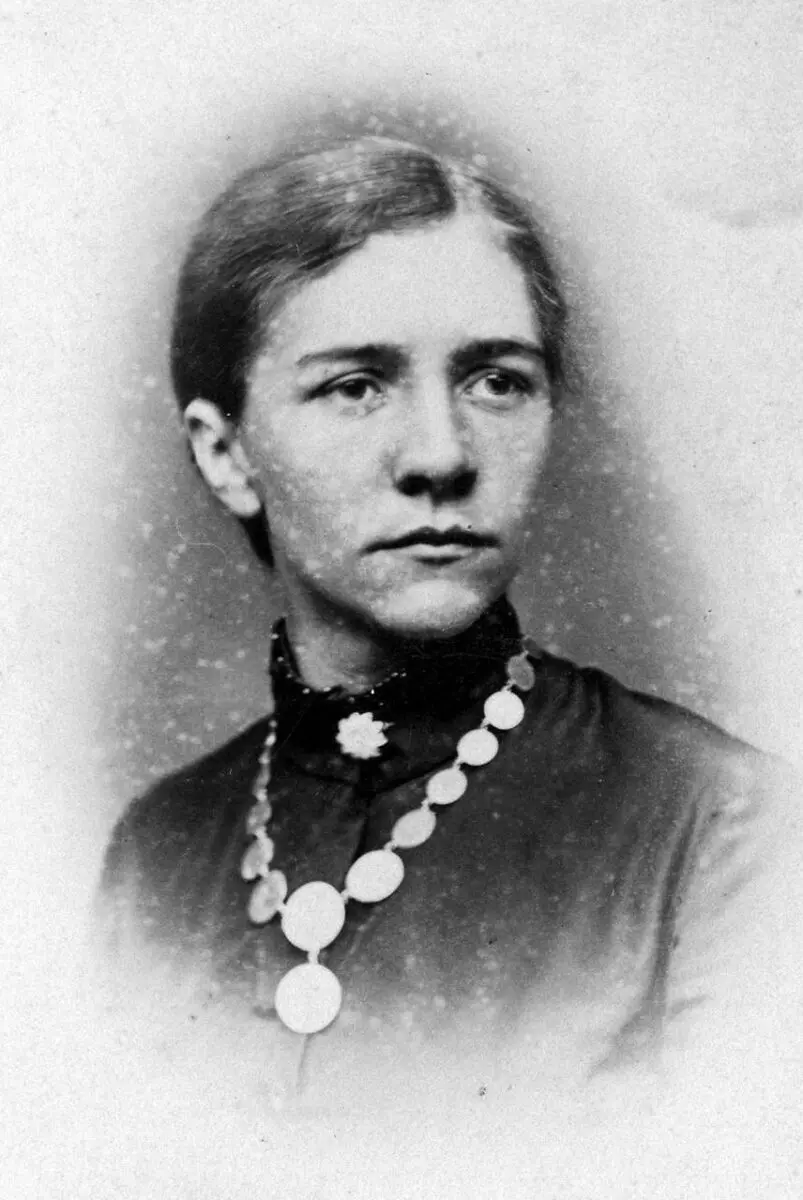
Amalia Joensen. Source: The National Museum of the Faroe Islands
Amalia Joensen was buried on May 5th 1944. She was among the first women to graduate from the School of Education in Tórshavn. The School opened its doors to women in 1884 and the first five graduated in 1887. Amalia was the only one from Tórshavn.
For many years she ran a private school in the Christinesminde building on the banks of Rættará River. The house was previously home to the Catholic priests posted to the Faroe Islands, and the Catholic Church had been located in an annex to the house. An arch of whale jawbones still adorns the front of the house. They are a memento of the time Amalia and her husband, Johan Carl Joensen (1857-1907), spent in Greenland. The husband was a colony administrator there and became commonly known as Greenland-Johan.
In 1907 Amalia became a young widow. A year later she opened her private school. Her pupils included Eiden Müller, who mentions her in his memoirs: ‘She ran a private school at Christinesminde, and those were blissful school years. She could be strict, but always fair; my brother Ebbe attended one of the older classes. She treated all children the same, even though she was our great-aunt.’
Amalia was the daughter of a Faroese district commissioner, Hans Christopher Müller. Like her sister, Petra, she was active in civil society. The sisters were both board members of Føroya forngripafelag (The Faroese Museum Society), along with Elsa B. Debess (Little Elsa) and Jóhanna í Dali. In 1946 the periodical Fríu Føroyar credited these trailblazers:
‘… that the artefacts were so well cared for, in particular the old and precious garments, is thanks first and foremost to these women. They kept them safe through the many years when the Museum Society had no storage facilities; they also contributed to raising the funds that made the Society part owner of the house where the heirlooms of the Faroe Islands are now housed.’
In those days the Museum kept its treasures in the attic of the library at Debesartrøð. In 1935 Amalia attended the founding meeting of the craft home industry association Føroya Heimavirkisfelag. In her youth she was one of the actors to put on the first play in Faroese, Veðurføst (Detained by Weather), by Helena Patursson, which was performed on Shrove Tuesday in 1889.
Sources:
Á 82-ára føðingardegi. In: Fríu Føroyum. 27th February 1946. Tórshavn.
Føroya Fornminnissavn, søga og virksemi (edited by: Andras Mortensen). 2002. Tórshavn.
Føroyskt Heimavirki 40 ár. In: Dagblaðið 3rd December 1975. Tórshavn.
Háberg, Petur. Hugbirtingar. 1981. Tórshavn.
Joensen, Amalie. In: Dimmalætting 3rd May 1944. Tórshavn.
Johannessen, Birgar. Havnin – fólk og yrki 1900-1939. 2007. Tórshavn.
Lützen, Chr. Úr søgu Læraraskúlans. In: Skúlablaðið October, 1945. Tórshavn.
Müller, Eiden. Minnislýsingar. 1981. Tórshavn.
Simonsen, Malan. Bylgjurnar leika í trá. 1992. Tórshavn.
 torsinfo@torshavn.fo
  +298 30 24 25
  Facebook
  Instagram